Tuesday, September 25, 2007

How much social capital do you contribute?

So, who are you, anyway? How do our readers compare with the general public when it comes to social capital?

Take our totally unscientific survey. It shouldn't take more than 2 minutes to complete the 5 questions, unless you decide to write a lot in the feedback box.

We'll publish the final results next month. You can check out the responses to-date here.

Diversity Reduces Social Capital

Introduction to our diversity series

The internet has been a-buzz with diversity talk since August 5th when Michael Jonas published his Boston Globe article "The downside of diversity" about Robert Putnam's work.
Putnam's research prompts soul-searching for those of us committed to increasing tolerance and respect among people in our diverse communities.

What does this research mean for our program design? What will bring about the results we want - a community where diverse peoples live fulfilling lives, support their neighbors, and engage in the life of the community?

This special series of five posts reviews Putnam's findings and shares some initial reflections from Dominick Brancato and Mike Baver, our Mosaic Coalition coordinator. In addition, we provide some links and thoughts about where to go from here.

We've also included a brief, decidedly unscientific poll we'd like you to complete. How different are you, our readers, from the general population when it comes to civic engagement? We'll share the poll results with you.

We encourage you to read the complete Jonas article and visit the links to Putnam's Sagauro Seminar and Better Together websites as you think about the implications of this research for your community and for your work.

The Diversity Paradox: The Turtle Effect & Creativity at Work


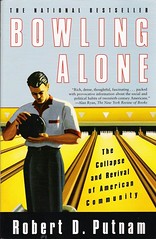
"People living in ethnically diverse settings appear to 'hunker down' -- that is, to pull in like a turtle," writes Harvard political scientist Robert Putnam. Putnam, already famous for his 2000 book, Bowling Alone, on declining civic engagement, has now measured the impact of ethnic diversity on civic health.

Putnam interviewed nearly 30,000 people across the United States. In his analysis he controlled for every conceivable factor independent of ethnic diversity that could depress 'social capital,' like community size, income range, mobility, and crime rate. But the correlation remained strong: higher diversity means lower social capital.

Jonas, in his Globe article, describes Putnam's findings:

--the greater the diversity in a community, the fewer people vote and the less they volunteer, the less they give to charity and work on community projects. In the most diverse communities, neighbors trust one another about half as much as they do in the most homogenous settings. The study, the largest ever on civic engagement in America, found that virtually all measures of civic health are lower in more diverse settings.

These measures of civic health are known as "social capital," what the World Bank calls "the glue that holds societies together and without which there can be no economic growth or human wellbeing."

This decline in social capital in diverse communities was not the result Putnam expected, nor one that he, or we, can ignore. Increasing diversity is certainly inevitable. Our communities can't afford to have civic engagement continue to decline.

Jonas also reports that a parallel line of research suggests that ethnic diversity can be a big asset in driving productivity and innovation. Scott Page at the University of Michigan found that the different perspectives generated in ethnically diverse work teams bring a creative tension. That tension can vault the team forward to cutting edge solutions.

We need to find ways to tap that productivity and innovation to enrich our 'social capital.'

Dom's September Wanderings

On my mind --

I've spent some time recently surfing the websites highlighted in this issue and I'm so pleased to have found a new community of people whose research and thinking supports the NY Center's mission of strengthening relationships, building community.

While I came away from my surfing with several ideas about next steps, I have to admit some pride in the fact that we're doing many things every day that build social capital.

Volunteers provide most of our mediation services.

Our youth program staff have been investing increasing energy in engaging parents, from regular phone calls to career help, like the medical billing course, for unemployed parents.

The Mosaic Coalition not only sponsors the annual Celebrate Diversity! Event; it offers an opportunity each month to break bread and share information and concerns with representatives from a number of the ethnic, religious, and cultural organizations on the Island.

And, we work hard to engage the young people in our programs in community service learning. We want them to develop habits of civic engagement and experience their ability to positively impact their neighborhood and the larger community.

Whether it's against the war in Iraq, the injustice in Jena, a new housing development, or a half-way house that wants to locate near us, so much of what motivates people to get involved these days is negative. We try to balance that with positive formal and informal opportunities to build relationships.

We invite our community to celebrate holidays, graduations, and award ceremonies with us. We build sharing food into every event. We hone our skills at facilitating dialogue to build bridges. And we love good old fashioned fun like games and talent shows.

Of course we can do more and we can do better.

There's so much to do that I've become increasingly cognizant of the importance of shaping each activity to gain maximum impact. We have to leverage every resource to meet many needs. I'm looking forward to exploring the Saguaro Seminar program evaluation tool. I hope this tool will be useful in that process.

I'm also looking forward to the results of our first poll. I hope you'll participate Watch for the results next month.

Enjoy these lovely fall days.

-- Dominick

Attitudes Reflect Leadership

Commentary from Mike Baver:

According to Robert Putnam, friendships, religious congregations or neighborhood associations are clear indicators of civic well-being, a term he defines as "social capital."

Apparently, the more diverse the community, the less "social capital" exists.

I'm not going to claim I know the answers to why this is. I also won't pretend to have an answer to alleviate the situation. I do believe strongly, however, that attitudes reflect the leadership.

Last week the events in Jena, Louisiana rocked our nation, thrusting race and ethnicity issues back into the forefront of American concepts of community. Closer to home, tensions continue to mount in Port Richmond, here on Staten Island, between the Mexican and African American communities.

Immigration issues evoke intense debate in the presidential election, while promoting ethnic understanding seems to have been pushed to the side. Politicians rant about Iraq, the environment, healthcare and many other hot button issues. They're important issues, too, but our communities are being ripped apart through 'fear of thy neighbor.'

The United States is referred to as the "melting pot" but it takes strong leadership to stir us together into a society of acceptance and tolerance. The Administration of our country, present and future, must do more to promote education through interaction.

Increasing social capital will also take the attention of local organizations and civic leadership.

The Mosaic Coalition members are all Staten Islanders who come from different backgrounds and who share a desire to improve the community. As local leaders, we need to consider what more we can do to offset the turtle effect of diversity.

On Sunday, November 4th, the Mosaic Coalition will orchestrate our 5th Celebrate Diversity 2007 event. Last year over 1,000 people learned about their neighbors interactively through workshops, performances, and games. Each year, our focus has been on the attributes that make the honored cultures wonderful and unique.

This year, in response to Robert Putnam's provocative and telling research, we will do more to highlight our similarities as well.

Four things we can do to increase social capital


Robert Putnam and his colleagues founded the Saguaro Seminar to focus on expanding our knowledge about levels of trust and on strategies to increase community engagement. and strategies and efforts to increase this engagement.

We build social capital by creating new ties and strengthening old ones. -- The new ties may be formal, like a club, association, or civic institution, or informal, like a group of friends talking or colleagues collaborating. There is no limit to the number of specific pathways to social capital creation http://www.ksg.harvard.edu/saguaro/faqs.htm

The following four strategies serve as our starting place at the NY Center. We hope you'll participate with us.

  • SPREAD THE WORD - talk with each other, our staff, family, volunteers, and friends. After all, action starts with awareness.

Tuesday, September 04, 2007

Kids: 10 ways to entertain young children for $1 or less (without the TV) - Lifehacker


Kids: 10 ways to entertain young children for $1 or less (without the TV) - Lifehacker:
Sick of paying hundreds of dollars for toys your kids don't play with? Tired of the latest toy catching your child's attention and having it turn out to be something you consider offensive (Bratz) or impossible to acquire (break dancing Elmo)?"

Thought you might be interested in this post from Lifehacker. Check it out.