Thursday, November 30, 2006

Should We Offer Mediation for Probate Issues?

I'm impressed by the variety of ways mediation shows up in the the UK. Do you know of mediators here in the states who include probate issues in their practices ?


Legal Week

All probate lawyers know the range of issues that can arise. A son argues against a stepmother: why have I been left out in favour of you� A first wife fights a second wife or a mistress. A daughter who cared for the deceased fights a brother who cared not at all, or so she says. Inheritance family provision claims abound. And there are complicating factors -- the will can aggravate pre-existing problems, bringing into the open long-running squabbles which may have simmered beneath the surface.


powered by performancing firefox

Tuesday, November 21, 2006

What's the Best Way to Market a Mediation Practice?


Looks like mediation marketing has graduated into the realm of a potentially lucrative niche market. Here's another direct marketing system to help mediators develop their practices. Kristina Haymes, MA, JD. has issued this press release. Anyone know whether her product is any good?
New Mediation Business & Marketing Success System Reveals Secrets - PR.com: "New Mediation Business & Marketing Success System Reveals Secrets

New multi-media product reveals success secrets of world class mediators and teaches mediators and conflict managers how to attract clients and build their dream practice."

Monday, November 20, 2006

Anglicans Explore Restorative Justice. Why not NYSDRA?

This report on a Canadian Anglican conference on Restorative Justice brought to mind an earlier report on the suit brought against IMAP and NYSDRA.

Anglican Diocese of Toronto: "Conference explores restorative justice

"Crime is more than the breaking of a law. It'’s the breaking of human relationships. How can we put things right?" - Dr. Pierre Allard

I can't help thinking that NYSDRA should consider introducing a restorative justice framework into the IMAP work with the victims of clergy sex abuse in the Albany Diocese. Money may help, but it doesn't necessarily facilitate healing.

I bet some face to face dialogue would go a long way in this situation. And, I suggest, since the church cover-up makes thdiocesanean hierarchy perpetrators of injustice along with the sex offenders, they should be participants in the process.

I appreciate how legally complicated the situation is, but it would be nice to see NYSDRA take the lead in exploring how to introduce a restorative justice framework.

Is it too late?

Wednesday, November 15, 2006

Mediation Keeps Kids at Home


Here's one way the British make talk work. They introduce their own version of parent-teen mediation nation-wide.

"The multi-million pound package will end the use of bed and breakfast hotels for 16 and 17-year-olds, provide training for youngsters, mediation for families, and emotional support."


Relate: Mediation can prevent homelessness: "Relate: Mediation can prevent homelessness
Tuesday, 14 Nov 2006 10:55
Relationship organisation Relate has praised the government for announcing mediation measures aimed at helping avoid homelessness.

Communities secretary Ruth Kelly will today announce measures – including mediation between families – to help get vulnerably housed young people back on their feet.

Relate's head of public policy, Jenny North, noted family breakdown was the major cause of homelessness for young people – government figures show this accounts for nearly a quarter of the 94,000 cases accepted by local authorities last year.

She said the government's commitment to the issue was clear from the backing Relate had received in developing a homelessness mediation service, and a standards framework.

'By working with families to reduce conflict and build bridges, we can help young people stay in the family home, and avoid homelessness,' Ms North added.

Relate today launches a pilot mediation service across 16 Relate centres nationwide to coincide with the 40th anniversary of seminal television drama Cathy Come Home.End of story"

Monday, November 13, 2006

Celebrate Diversity With Us Next Sunday

Location for Celebrate Diversity! -- Wagner College, 1 Campus Road, Staten Island
For directions and a map, see our calendar, click on Wagner College
Celebrate Diversity with the Mosaic Coalition
A Family Event Celebrating Our Roots
November 2006 - A Special Issue of Exchange On Line
To all our friends and colleagues --

We hope you and your family will join us this Sunday afternoon. Celebrate Diversity! brings together hundreds of our friends and neighbors to learn about the customs and traditions that make us unique.

Each year we spotlight a handful of countries. This year we are pleased to honor Ghana, Norway, Sri Lanka, the Philippines, and the Dominican Republic.

Come share good food, music, dance, and camaraderie. Yes, it's this coming Sunday afternoon and it's free admission for all.

Celebrate Diversity with Us!
Sunday, November 19, 2006

Spotlight on Our Neighbors
Enjoy the music and colorful costumes as our neighbors from this year's honored cultures share their performances and acknowledge their civic leaders.
  • 2:00 PM Sri Lanka
  • 2:40 PM Philippines
  • 3:20 PM Norway
  • 4:00 PM Dominican Republic
  • 4:40 PM Ghana
  • 5:20 PM Student Banner & Essay Awards
  • 5:45 PM Remembering Victims of Hate Crimes - a moment of silence and a Community Sing-A-Long - "We Are The World"


Activities for Children

Your children can have their 'passports' stamped as they travel from country to country in the Marketplace. A full passport merits a Celebrate Diversity! T-shirt.

An ethnic-themed puppet show will inspire your children to make their own puppets. Paint will flow on faces, child-designed t-shirts, and coloring projects. Children's stories, theater readings, and sing-a-longs will introduce them to the various cultures. And, prizes, prizes, prizes!


Celebrate Diversity!
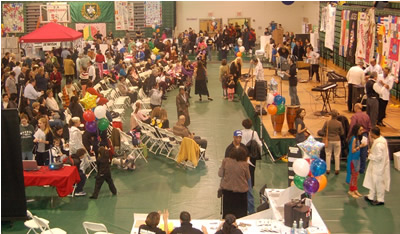
Visit the Marketplace and performance stage. These pictures from past Celebrate Diversity! events capture some of the wonderful variety and color of the afternoon.
Irish pipers & drummers
Celebrate Diversity! Pipers and drummers share their Irish heritage.
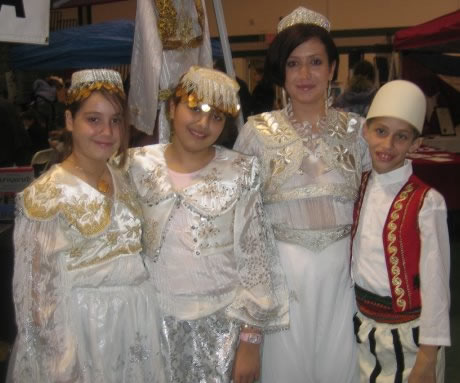
Albanian Dancers
The rich costumes of the Albanian dancers capture our imagination. Through music and dance we travel around the world.
Mexican Dancers
Playing games together helps break down barriers. When you share laughter and tears, stories, and food, the world seems a bit smaller and our community much more friendly.
Mosaic Coalition
Celebrate Diversity! is planned and executed by the Mosaic Coalition at their monthly potluck supper-meetings. If you would like to learn about the cultures and traditions that make our community rich, please join us.

This annual event is co-sponsored by the NY Center and Wagner College. It's part of our commitment to 'Strengthen Community.'

I look forward to seeing you Sunday. And, please forward this to your friends and family. Encourage them to join you there.

Sincerely,
Dom Brancato signature

Dominick J. Brancato, Executive Director
NY Center for Interpersonal Development

Gmail

Sunday, November 12, 2006

Gary Goes to the Citizens Police Academy - S.10

Session 10 was very valuable in a way I am no so sure the very affable Detective Quinones intended it be. A major point of the Citizens Police Academy, if not the major point, is for the community to have a better idea who those people are that make up the NYPD. Session 10 certainly gave us that.

Throughout session 10 Detective Quinones peppered his description of the terrorists as "knuckleheads" and "nuts."” Though he did have grudging respect for the terrorists, Detective Quinones was clearly more comfortable seeing the terrorists as "not like the rest of us."

We were told right up front that, "Anyone who tells you there are not terrorists here ready to strike, has just pocket your picked." We saw some to the multi-ethnic faces of the terrorist groups. Since terrorists are in every country, we saw only the most highly publicized faces. Though they were characterized as "nuts" we learned about the men, and a single woman, who had formed armies, raised money (in one case over a billion dollars), or had simply acted alone, in order to perform terrrorist acts. Terrorists were very clever in evading detection, but never for long. So, in the end they were not so clever. We learned the terrorists make "idiot" mistakes. We also learned that if you visit certain websites, and downloaded certain material (e.g., an Al-Qaida training manual) you can anticipate the full weight of the government coming down on you. We also learned if you, knowingly, or unknowingly, rent a room to a terrorist you could serve jail time. We learned how terrorist suspects are arrested,"“Never to be heard from again." We also learned that despite the national debate, the United States does not torture terrorists.

Detective Quinones is highly educated. He is on his way to a doctorate in religion, and he is a 20-plus year veteran of the police force. So I was more than a little surprised by his very black and white perspective regarding terrorists. I do not recall any of the other officers/instructors exhibiting what came off as a very strong "us" versus "them" mentality. I saw a lot of respect and concern for the public from most of the other officers/instructors. Still, I should have not been surprised by Detective Quinones's attitude.

Detective Quinones in his position with the Joint Terrorist Task Force views himself as being an integral part of the war effort. His job, in large part, is to help us forget the United States is at war. When you are at war, your job is to kill the enemy. Compassion and understanding are potentially lethal hinderances to that job. Also, in considering Detective Quinones's session I thought back to the 3rd session where Detective Fox, with the Child Abuse Unit, told us he copes with his job by moving on mentally, when he finishes each case. I thought how the "us" versus "“them"” mentality allows Detective Quinones to do his job, and since Detective Quinones has limited contact with the general public, his "us" versus "“them"” mentality is able to remain a very private face of the NYPD.

Unlike most police officers whose job is, according to our reading for session 3, to "make every effort to perform your duties professionally, thoroughly, and with compassion and respect for the citizens of this city;" Detective Quinones's job is to protect all of us from them (i.e., the terrorists). Those that have declared war on all of us. As a citizen I think it valuable to know there is this "us" versus "“them"” face to the Police Department, as we look at a police department which in large part shows "“respect for the citizens of this city."

Friday, November 10, 2006

What Works in Youth Development?


The second issue of the new refereed journal, Journal of Youth Development: Bridging Research and Practice, is now available on-line on the National Association of Extension 4-H Agents website.

This issue features the following articles:

* Integrating Youth Into Community Development by Rosemary V. Barnett and M. A. Brennan


* Qualitative and Quantitative Assessments of Thriving and Contribution in Early Adolescence: Findings from the 4-H Study of Positive Youth Development by Amy Eva Alberts, Elise DiDenti Christiansen, Paul Chase, Sophie Naudeau, Erin Phelps, and Richard M. Lerner


* Relationships Matter: A Mixed-Methods Evaluation of Youth and Adults Working Together as Partners by Kenneth R. Jones


* Supporting Social and Cognitive Growth Among Disadvantaged Middle-Grade Students in TASC After-School Projects by Christina A. Russell and Elizabeth R. Reisner


* Experiential Learning: A Process for Teaching Youth Entrepreneurship by Karen Biers, Christine Jensen, and Ellen Serfustini


* An Introduction to the SMARTRISK Heroes Program: Positive Social Marketing for Adolescent Injury Prevention by Philip R. Groff, Michael Shea, and Robert Conn


* Rethinking Concept Mapping for Youth Participatory Evaluation in the Context of Youth Development Programs by Jennifer Southwick Brown


* Statistical Testing of a Measure of Youth's Perceived Improvement in Life Skills by Lisa A. Guion and Blanca E. Rivera


* Findings from Five Out-of-School Time Focus Groups: Professional Development Preferences, Experiences and Recommendations for Future Planning by Jennifer Buher-Kane, Nancy Peter, Stacy Olitsk, and Susan Kinnevy


* Nebraska 4-H Household Technology and Interest Survey by Bradley S. Barker and Debra K. Meier

* Youth Development and Extension Family and Consumer Sciences by Jan F. Scholl

Sunday, November 05, 2006

NY Center's Blog SpotGary Goes to the Citizens Police Academy – S. 09

Who is watching the wild youth?

That seemed to be the theme for the a la carte evening which was session 9 of the Citizens Police Academy. In one evening we heard from a sergeant with the Anti-Gang Squad; a father whose teenage son was killed by a gang member; the Youth Services captain; and finally, a sergeant in School Safety. All were very much versed in the “what” of their expertise, but lacking in causality.

The evening began with a fascinating peek behind the veil of gang culture. We learned about gang initiation, we learned about the unique gang language, we learned about the gang “steps,” and we learned about the myriad of signals which gang members use to identify other gang members. All this in a little over a half-hour. When the instructing sergeant was asked what need the gangs filled for its members, we were told that gang members did not get enough hugs at home, and gangs were their family. Unfortunately, the sergeants explanation only covers why gang members would alienate themselves from their families, or their fragmented family. Her explanation failed to explain why gang members would choose to indulge in, what appears to be, self-destructive behavior. My guess is there exists a strong element of hopelessness in creating the gang counterculture.

Next we were treated to a heartfelt interlude by the father of a teenager recently killed by a gang member, ostensibly over an iPod. The father briefly spoke of what happened to his son. He blamed his son’s death on a gang member, and by inference, gangs. Since his son’s death, this gentleman has dedicated himself to creating safer neighborhoods by working against gangs. However, he seems to have done little, and given little thought to, addressing the reasons gangs exist in the first place.

The next speaker was from Youth Services, and spoke about the many opportunities made available to the youth in each community by the NYPD. I understand the Explorers, the Youth Police Academy, and the Police Athletic League all are great programs for the youth in the communities. Still, a little about the original thinking behind creating these groups would have given us a much fuller picture.

The last speaker, (more appropriately speakers, led by a sergeant), spoke about School Safety. The sergeant had the amazing ability to turn the mundane into the monumental. The relatively routine wanding of students for weapons, in this officer’s hands became an art form. Where the sergeant fell flat was in explaining the “why” of what he did. He told us under no circumstances, may a female student be wanded by a male officer, because of the possibility of false accusations. Then by way of example, he told us how a female officer was wrongfully accused of doing inappropriate wanding by a group of malicious girls. He used a similarly inappropriate example in explaining how everyone must be wanded, even teachers who would be given a free ride if they had walked through the teacher’s entrance. So, it is unclear why they were being wanded because they walked through one entrance, and not the other. Then there was the talking technique to discover weapons hidden in the mouth. The sergeant gave an example which showed this technique to be useless at detecting weapons in the mouth. So, in the end, it is unclear why the talking technique is used at all.

Despite issues with session 9, what we did learn made for an, in turns, fascinating, moving, informative, and entertaining evening. So, there was actually much to be gained from session 9.

Next week it is counter terrorism. I am looking forward to more than just, “if you see something, say something.” In any case, I shall certainly see something, and say something.

I am so very there!

Thursday, November 02, 2006

What message do the kids get?

Here's something I never thought about -- Carlos was responding to a speaker recommendation posted on the ONDCP Community Prevention Listserv. The poster raved about the powerful speaker, a fellow in recovery, her coalition hosted at several schools. What do you think about Carlos' point? Agree? Disagree?
Hey Y'all:
Not a good idea to bring a recovering addict to speak to kids, no matter how "dynamic". The usual message that get's through is: "Look I did dope, I had some problems but now I'm famous!). Can you use a recovering addict? Yes, but for a population that has already been exposed.... not as a prevention tool.
Just a thought

Carlos Cruz
"Think About It"
Drug & Gang Prevention

Update -- Whew! this post generated alot of comments, both pro and con, on the listserv. I'm interested in what you think.

Wednesday, November 01, 2006

Mediation over child welfare a big saver

Here's another interesting application for mediation.

San Luis Obispo Tribune | 11/01/2006 | Mediation over child welfare a big saver: "Mediation over child welfare a big saver
A nonprofit estimates local taxpayers have saved $255,510 by avoiding court hearings
By Sarah Arnquist
sarnquist@thetribunenews.com

Local families in the county’s child welfare system are now settling many of their concerns and conflicts out of the courtroom through a new mediation program that’s saving local taxpayers thousands of dollars.

Following the success of similar programs in other counties, San Luis Obispo nonprofit Creative Mediation joined with the county’s Department of Social Services and the Juvenile Court last year to launch a Juvenile Dependency Mediation progra"